Bumper Crop: The Retired Couple Cataloging America's Weirdest Parking-Lot Confessions
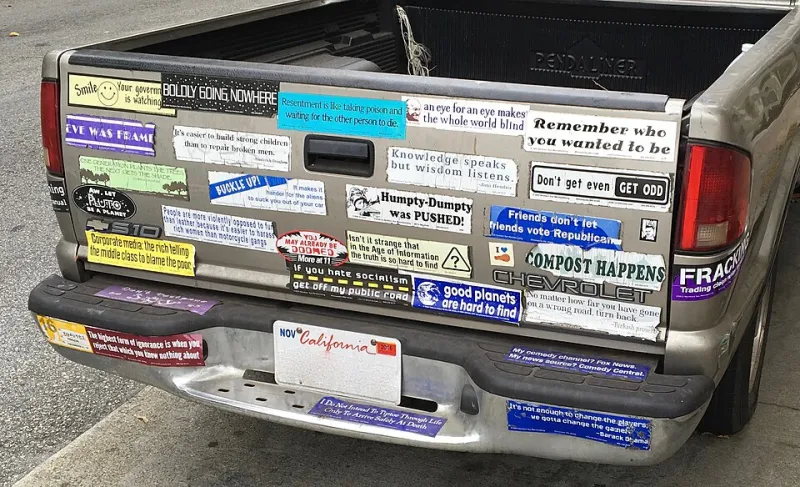
Photo: Kingofthedead, CC BY-SA 4.0, via Wikimedia Commons
It Started With One Insulting Sticker in a Cracker Barrel Lot
Dale Voss was circling a parking lot outside Columbus, Ohio, waiting for his wife to finish up inside, when a Ford Ranger caught his eye. The bumper was doing a lot of talking: a stick-figure family, a faded yellow ribbon, a college logo, and one sticker that read, in bold black type, "I'm not arguing, I'm just explaining why I'm right."
He laughed. Then he took a picture. Then he took eleven more before Marlene got back to the car.
That was the spring of 2023. Today, the Vosses — a retired postal carrier and a retired dental hygienist, married thirty-one years — run what they call the Rear Window Registry, a loose, wildly specific archive of roughly 4,200 bumper stickers photographed across 38 states. Dale shoots and logs. Marlene grades and writes the blurbs. There is a spreadsheet. There are folders. There is, apparently, a color-coded system for rust.
"People think we're out there judging," Marlene said. "We're not. We're just out there noticing. There's a difference, and it took me about a year to convince Dale of it."
The Rules of a Very Weird Field Science
What separates the Registry from a phone full of random snapshots is the method. Every entry gets the same treatment: a photo of the sticker in context (whole vehicle, plate blurred, no faces), a GPS pin to the nearest intersection rather than the exact spot, a date, and a rough condition grade from 1 (crisp) to 5 (held together by hope and sun damage).
They also keep a note on the vehicle itself. A minivan sticker hits differently than a lifted truck sticker, and both hit differently than a bumper sticker slapped onto a mail truck or a church bus.
"Context is everything," Dale said. "You see 'Honk if you love Jesus' on a Corolla, that's one thing. You see it on a 1987 Winnebago with a full bookshelf in the back, that's a whole personality."
The couple has a short list of things they won't catalog: anything with a slur, anything targeting a specific named person, anything photographed while the owner is in the car. If someone asks what they're doing, they explain. If someone says stop, they stop. That rule came after a tense exchange in a Walmart lot in Indiana that Dale describes only as "educational."
A Taxonomy Nobody Asked For
Ask Marlene about categories and she'll pull out a laminated index card like she's about to explain a wine list. The Registry sorts into six buckets:
- Boasts — honor students, marathon finishers, kids who made the dean's list three time zones away.
- Benedictions — bless this truck, pray for the driver, angels riding shotgun.
- Grievances — the loud, the passive-aggressive, and the ones that are technically about a neighbor's dog.
- Creed — politics, faith, and the fallout of both, usually applied two presidential cycles ago.
- Bit — the jokes. The puns. The stickers that were clearly an impulse purchase at a gas station in Missouri.
- Tender — and this is the bucket that surprises people. The memorials. The "in loving memory of" decals. The name of a dog that has been gone for a decade and still rides in the back window.
"The tender ones are the whole reason I kept going," Marlene said. "You drive behind someone at a red light and you realize you're looking at a memorial. That's not a joke. That's somebody's front porch on wheels."
Why This Counts as Folk Art (Really)
There's an argument, and the Vosses make it politely, that the bumper sticker is the last truly democratic American art form. It costs four dollars. It requires no gatekeeper. It goes up in a parking lot with no ceremony and stays up until it peels or the car dies. Nobody curates it, nobody funds it, and nobody agrees on it.
That's also why it disappears. Sun kills stickers. Repaints kill stickers. Resale kills stickers. A car gets totaled and fifteen years of personal philosophy goes to the crusher with it.
Which is, more or less, the pitch: this stuff is ephemeral, and ephemeral things are worth somebody's camera roll. Think of it as the same instinct that sends people out to photograph hand-painted signs, front-yard shrines, and the small-town murals that get paved over the moment a chain pharmacy wants the lot.
The Parking Lot Is the Venue
Part of the appeal is that the Registry is free to visit and open 24 hours. A county fair costs forty bucks. A parking lot behind a Piggly Wiggly on a Sunday morning is the cheapest museum in America, and the exhibits rotate constantly.
The Vosses have a few favorite hunting grounds. Long-term airport lots, where cars sit for a week and their stickers bake into a patina. High school lots during graduation season. Anywhere near a state fairgrounds in August. And, reliably, the outer rows of a Buc-ee's, where a cross-section of the entire interstate parks in one place and then eats a brisket sandwich.
They've logged a sticker advertising a defunct radio station that went dark in 2011. They found three different cars in three different states bearing the same obscure inside joke from a 1990s regional ad campaign. Dale is still bothered by that one.
How to Hand Over Your Own Find
The Registry takes submissions by email — a photo, a city, roughly where the lot is, and the condition grade if you're feeling ambitious. The Vosses verify by cross-checking the location and, when possible, asking the person to grab a second shot from a different angle. They've turned down plenty of forwarded screenshots from the internet; if it wasn't shot in a real parking lot by a real human, it doesn't get a number.
Their advice for first-timers is simple. Don't stage anything. Don't peel a sticker off and pose it. Blur the plate. Don't linger. And don't decide in advance what you're looking for.
"The good ones find you," Dale said. "You're walking into Target, and there it is — ten words that tell you everything about a stranger you'll never meet. That's the whole thing. That's the hobby."
Marlene is currently lobbying for a coffee-table book. Dale wants to finish all fifty states first. They've got twelve to go, and a road atlas with a lot of little pencil dots already on it.